
 By
By 
Pascal Laugier has always insisted that Martyrs was born from a place of raw honesty rather than provocation. Speaking about the film’s origins at the time of its release on DVD in the UK, he admitted to Eye for Film that he can’t pinpoint a single moment of inspiration: “I don’t know precisely. I think that if we knew where the idea had come from we probably wouldn’t have done the film.”
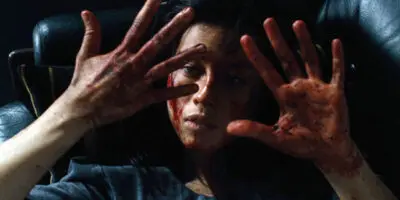
What he does remember is the first image that drove him: “I started to write the script by thinking about the revenge sequence, the girl knocking at the door and killing the members of an apparently regular middle class family.” From there, he followed the emotional logic of the characters. “Little by little, I got the whole story… the more I realised how violent and brutal it was, I started to realise at the same time that the violence and the brutality was the point of the film.”
For Laugier, Martyrs was not conceived as a shock machine but as a deeply personal expression of despair. “When I wrote the script I felt very dark on an intimate level,” he explains. “I was very receptive to the violence of our times.” He wanted to use horror as a direct conduit for emotion rather than irony or commentary. “I didn’t want to have any kind of distance between me and what I was writing. I wrote the script in a very melodramatic way, feeling very close to my main characters.”

This closeness shaped the film’s intensity. Laugier insists, “It’s not a film about torture. It’s a film about suffering.” His goal was to make the audience feel pain as the characters do: “I really needed the audience to feel the pain, to reach our limits… maybe it would reach another level after the pain, like my main character does.”
Structurally, he always envisioned Martyrs as a three‑act descent, admitting he feared the transitions. His aim was to destabilise viewers: “My goal as a narrator was trying to surprise the audience… I liked the idea that after a while, the audience would wonder, ‘What am I fucking watching?’” This unpredictability was his rebellion against what he saw as a stagnant genre. “Today, as a horror fan, I was starting to think that the genre was more harmless and formulaic… I tried to bring something unexpected and something fresh.”
The film’s release brought immediate controversy. France’s ratings board initially attempted to bury it with an 18+ classification. Laugier recalls, “These people have found a new way to kill films… when you are ‘forbidden under 18’, you are not released, it’s pure and simple, your film is dead.”
He fought back, eventually winning a 16+ rating. He remains unapologetic: “I know this film has shocked some members of the commission… am I happy to have shocked them?” Audience reactions were equally divided. “Some horror fans hated the film because it didn’t deliver what they expected… some general audiences were moved by it.” He accepts all responses: “It’s very legitimate that some people hate the film. It sends so much bad energy… it’s so nasty, so depressing and so sad.”

Laugier sees Martyrs as part of a wider eruption of French extremity. “I think it’s a matter of frustration… in France we are living in very brutal times, and one of the ways to talk about the brutality of our times is to reflect that in horror films.” As for Hollywood’s interest in him after Martyrs, he is cautious but pragmatic: “After Martyrs, I was proposed one project from France, and 50 projects from America… you go to people who desire you more.”
What emerges from Laugier’s reflections is a portrait of a filmmaker driven not by cynicism, but by conviction. “For me, cynicism is the end of everything,” he says. Martyrs is his antidote — a film made in absolute first degree, with no safety net, no distance and no compromise.
Discover more on Top 10 Films
The 14 Most Controversial Movies Of The 2000s

From graphic realism to moral outrage, these 2000s films sparked fierce debate over censorship, sexuality and violence.