
 By
By 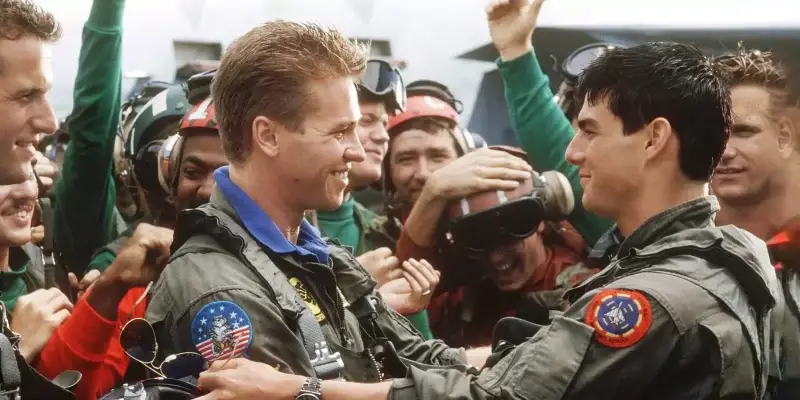
Quentin Tarantino has delivered plenty of memorable monologues in his own films, but one of his most famous speeches appears in a movie he didn’t write or direct. The 1994 romantic comedy Sleep With Me has mostly faded from public memory, yet Tarantino’s cameo — a breathless, boozy breakdown of why Top Gun is “a story about a man struggling with his own homosexuality” — has taken on a life of its own. It’s the kind of scene that spreads by word of mouth, resurfaces on YouTube every few years, and reminds audiences of Tarantino’s early, unfiltered charisma.
What makes the moment even better is that it wasn’t scripted. As Tarantino later explained, the rant originated long before Sleep With Me was ever made. Back in the late ’80s, he and Roger Avary were working at the now‑legendary Video Archives rental store, where the pair would spend hours debating films, inventing theories, and performing impromptu routines for friends. One of those routines was the Top Gun bit — a comedic, conspiratorial reading of Tony Scott’s blockbuster as a coded queer romance. “Roger did come up with it first,” Tarantino said, “but we worked on it, we turned it into a routine that we did at parties.”
- Be My Wingman: 10 Unforgettable Moments In Top Gun
- The 10 Best Movies Of “Top Gun” Director Tony Scott
- Inside Quentin Tarantino’s Writing Process: Character First, Plot Later
So when Tarantino arrived on the Sleep With Me set and was told to improvise something for a party scene, he already had a fully formed act in his back pocket. “I had that routine ready to go,” he recalled. “So I just did it and that became a thing.” The result is a monologue delivered with the same swagger and conviction as his “Like a Virgin” speech in Reservoir Dogs — a mix of pop‑culture analysis, comic exaggeration, and pure performance energy.
The theory itself is deliberately provocative but surprisingly coherent. Tarantino’s character argues that Maverick is torn between two paths: the “normal way,” represented by Kelly McGillis’s Charlie, and the “gay way,” represented by Iceman and the other pilots. He points to the film’s famously homoerotic volleyball scene, the locker‑room confrontations, and the emotional intensity of Maverick and Iceman’s rivalry. The kicker, he says, comes in the final scene, when Iceman tells Maverick, “You can be my wingman anytime,” and Maverick replies, “Bullsh*t… you can be mine.” For Tarantino, that’s the moment the “gay way” wins.
Part of why the rant endures is that Top Gun genuinely occupies a fascinating space in ’80s action cinema. Critics have since noted how the film blends traditional heterosexual romance with unmistakably queer-coded imagery — a combination that feels almost accidental, a product of a cultural moment when Hollywood action movies could be both aggressively macho and unintentionally homoerotic. As writer Nico Lang observed, Top Gun emerged at a time when a studio tentpole could be “very straight” on the surface while still radiating an entirely different energy underneath.

What’s refreshing is that the filmmakers themselves have never bristled at Tarantino’s interpretation. Producer Jerry Bruckheimer has even called it a valid reading, and the popularity of the rant didn’t influence the 2022 sequel in any defensive way. Top Gun remains what it always was: a high‑octane, hyper‑stylised slice of ’80s Americana that invites multiple interpretations — including Tarantino’s gleefully subversive one.
- 10 Times A Table Became An Additional Character In A Quentin Tarantino Film
- Why Tarantino’s “Once Upon A Time In Hollywood” Is His Best Film Since “Pulp Fiction”
- Samuel L. Jackson On The One Director He’d “Walk Through Fire” For
Three decades later, the Sleep With Me scene still circulates because it captures Tarantino at his most unfiltered: a movie‑obsessed raconteur turning a blockbuster into a cultural puzzle box. It’s a reminder that sometimes the most enduring film moments come from the margins — from a forgotten rom‑com, an improvised speech, and two video‑store clerks who couldn’t stop talking about movies.
Discover more on Top 10 Films:
Barefoot Girls: Does Quentin Tarantino Have A Foot Fetish?

Bridget Fonda’s feet are eulogised in Quentin Tarantino’s Jackie Brown.
Why do so many Quentin Tarantino movies feature close-ups of women’s feet? Does the Pulp Fiction, Jackie Brown and Reservoir Dogs director have a foot fetish?
FAQ
What is Tarantino’s Top Gun rant?
It’s an improvised monologue Tarantino delivers in Sleep With Me (1994), arguing — humorously but convincingly — that Top Gun is really about a man wrestling with his own homosexuality. The scene became a cult favourite thanks to Tarantino’s rapid‑fire delivery and pop‑culture analysis.
Where did the routine originate?
The rant began years earlier at Video Archives, the video store where Tarantino and Roger Avary worked. They developed it as a party routine, performing it for friends long before Tarantino reused it on camera.
Does the theory have any basis in the film?
While intentionally exaggerated, the theory taps into Top Gun’s well‑documented homoerotic subtext: the volleyball scene, the locker‑room tension, and the emotional rivalry between Maverick and Iceman. Critics have since explored these themes in depth.
How have the filmmakers responded?
Producer Jerry Bruckheimer has called Tarantino’s interpretation a valid reading. The popularity of the rant hasn’t influenced the franchise’s direction, and the sequel Top Gun: Maverick shows no defensiveness toward queer interpretations.